Introduction: Beyond California’s Pioneering Model
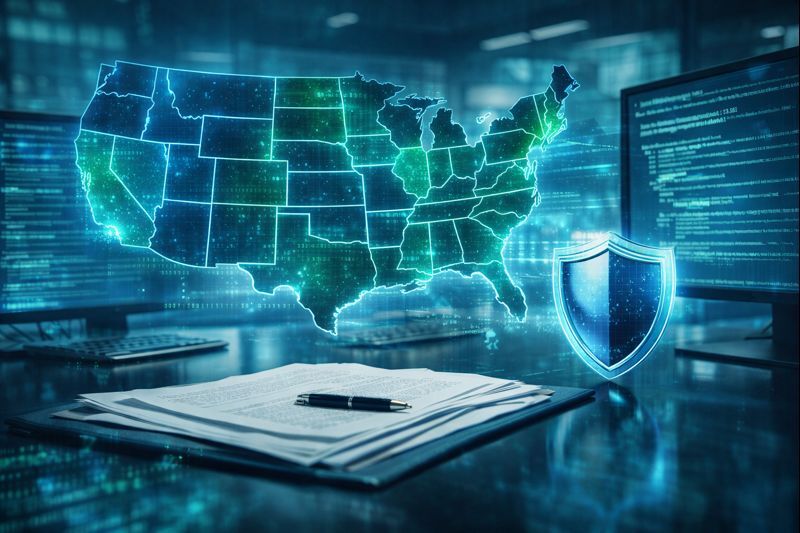
The data privacy landscape in the United States has undergone a dramatic transformation since California’s Consumer Privacy Act (CCPA) first took effect in 2020. What began as a single state’s ambitious attempt to regulate data collection and processing has evolved into a complex patchwork of state-level privacy laws that now affects businesses nationwide. As we move through 2026, legal professionals and businesses must navigate an increasingly intricate web of data protection requirements that varies significantly from state to state.
This regulatory evolution represents more than just compliance complexity—it signals a fundamental shift in how Americans view privacy rights and how businesses must approach data governance. The absence of comprehensive federal privacy legislation has created a vacuum filled by individual states, each crafting laws that reflect their unique priorities and constituencies.
The Current Landscape: A State-by-State Breakdown
The Second Wave: Virginia and Colorado Lead the Charge
Following California’s lead, Virginia and Colorado became the second and third states to enact comprehensive data privacy laws. Virginia’s Consumer Data Protection Act (VCDPA) and Colorado’s Privacy Act (ColoPA) both took effect in 2023, but their approaches differ significantly from California’s model.
Virginia’s law focuses heavily on consumer control and business flexibility, offering a more business-friendly approach that emphasizes reasonable data processing standards and streamlined compliance procedures. Colorado’s law, conversely, incorporates unique provisions for algorithmic decision-making and provides enhanced protections for sensitive personal information.
These variations have created the first major compliance challenge for businesses: understanding that “following California law” is no longer sufficient for nationwide data privacy compliance.
The Third Wave: Connecticut, Utah, and Beyond
Connecticut and Utah joined the comprehensive privacy law club in 2023, followed by a surge of additional states in 2024 and 2025. Each state has crafted laws that reflect local priorities and political climates, creating an increasingly complex compliance matrix for businesses.
Connecticut’s Act Concerning Personal Data Privacy and Online Monitoring focuses particularly on children’s data protection and includes some of the strongest consent requirements in the nation. Utah’s Consumer Privacy Act takes a more business-friendly approach but includes unique provisions for data minimization that go beyond federal requirements.
The 2026 Additions: Montana, Oregon, and the Midwest Expansion
The most recent wave of state privacy laws includes Montana’s Digital Privacy Act, Oregon’s Consumer Data Protection Act, and groundbreaking legislation from traditionally business-friendly states like Texas and Florida. These newer laws reflect lessons learned from early implementations and attempt to address gaps in previous legislation.
Montana’s law is particularly notable for its focus on rural privacy concerns and includes unique provisions for agricultural data protection. Oregon’s law incorporates environmental data protection concepts and includes provisions for location tracking that specifically address outdoor recreation privacy.
Key Differences That Complicate Compliance
Threshold Requirements and Scope
One of the most challenging aspects of multi-state privacy compliance lies in the varying threshold requirements for law applicability. While California’s CCPA applies to businesses that meet certain revenue or data processing thresholds, other states have adopted different approaches.
Virginia requires businesses to control or process personal data of at least 100,000 consumers annually or derive more than 50% of revenue from personal data sales and control or process personal data of at least 25,000 consumers. Colorado uses similar thresholds but defines “consumer” differently, potentially capturing different businesses.
These varying thresholds mean that a business might be subject to some state laws but not others, creating compliance complexity that requires careful legal analysis for each jurisdiction.
Rights and Remedies Variations
Consumer rights under different state laws vary significantly, creating operational challenges for businesses that must implement systems to handle different types of consumer requests. While most states provide basic rights to access, delete, and opt-out of personal data sales, the specific implementation requirements differ substantially.
California’s law includes a private right of action for certain data breaches, while most other states rely primarily on attorney general enforcement. Connecticut includes unique provisions for data portability that go beyond other states’ requirements, while Utah provides more limited consumer rights in exchange for streamlined business compliance.
Sensitive Data Categories and Special Protections
States have taken dramatically different approaches to defining and protecting sensitive personal information. Colorado includes biometric data and geolocation information in its sensitive data definition, requiring opt-in consent for processing. Virginia takes a more limited approach to sensitive data categories but includes unique protections for children’s data.
These differences require businesses to implement different data handling procedures depending on the state where consumers are located, creating significant operational complexity for national businesses.
Compliance Strategies for Multi-State Operations
The Gold Standard Approach
Many businesses are adopting a “gold standard” compliance strategy that implements the most restrictive requirements from all applicable state laws. This approach simplifies operations by creating uniform procedures but may impose unnecessary costs for compliance with requirements that exceed legal minimums in many jurisdictions.
The gold standard approach is particularly popular among technology companies and large retailers that serve consumers nationwide and prefer operational simplicity over jurisdiction-specific compliance optimization.
Jurisdiction-Specific Compliance Programs
Larger enterprises with sophisticated legal and compliance teams are increasingly implementing jurisdiction-specific compliance programs that tailor data handling procedures to the specific requirements of each state where they operate.
This approach requires significant investment in compliance infrastructure but can reduce unnecessary compliance costs by implementing only the requirements actually mandated in each jurisdiction. However, it also increases operational complexity and requires ongoing monitoring of changing state law requirements.
Technology-Enabled Compliance Solutions
The complexity of multi-state privacy compliance has created a robust market for technology solutions that automate compliance with varying state requirements. Privacy management platforms now include state-specific workflow tools that can automatically route consumer requests to appropriate handling procedures based on the consumer’s location.
These technological solutions are becoming essential for businesses that want to maintain compliance without dramatically expanding their legal and compliance teams.
Enforcement Trends and Litigation Risks
Attorney General Enforcement Patterns
State attorneys general have taken varied approaches to privacy law enforcement, with some focusing on high-profile cases that generate media attention while others emphasize industry education and voluntary compliance.
California’s Privacy Protection Agency has been the most active enforcer, conducting several high-profile investigations and imposing significant penalties. Other states have taken more measured approaches, focusing on compliance assistance rather than aggressive enforcement during initial implementation periods.
Private Litigation and Class Action Risks
The variation in private rights of action across different state laws creates complex litigation risk profiles for businesses. California’s private right of action has generated significant class action litigation, while states without similar provisions face primarily attorney general enforcement.
Businesses must assess litigation risks on a state-by-state basis and implement appropriate legal strategies for each jurisdiction. This includes everything from forum selection considerations to class action settlement strategies.
Cross-Border Enforcement Cooperation
State attorneys general are increasingly coordinating privacy enforcement actions across state lines, creating potential for multi-state investigations and settlements. This trend suggests that privacy violations in one state could trigger enforcement actions in multiple jurisdictions.
Industry-Specific Considerations
Healthcare and HIPAA Interaction
Healthcare organizations face unique challenges in navigating state privacy laws alongside existing HIPAA requirements. While most state laws include exceptions for HIPAA-covered entities, the scope of these exceptions varies, and many healthcare organizations collect data that falls outside HIPAA protection.
Healthcare technology companies, in particular, must carefully analyze how state privacy laws interact with HIPAA to ensure compliance with both federal and state requirements.
Financial Services and GLBA Considerations
Financial institutions face similar complexity in determining how state privacy laws interact with existing Gramm-Leach-Bliley Act (GLBA) requirements. State laws typically include exceptions for financial institutions subject to GLBA, but the scope of these exceptions varies significantly.
Fintech companies and other financial services providers that may not be fully subject to GLBA face particular challenges in determining which state privacy law requirements apply to their operations.
Retail and E-commerce Adaptations
Retail and e-commerce businesses face some of the greatest compliance challenges because they typically serve consumers in all states and collect a wide variety of personal information types. These businesses must implement comprehensive privacy programs that can handle varying requirements across all operating jurisdictions.
Many retailers are investing heavily in privacy infrastructure and legal expertise to manage these complex compliance requirements while maintaining competitive business operations.
Looking Ahead: Federal Legislation and State Preemption
Congressional Activity and Federal Preemption Possibilities
Congressional interest in federal privacy legislation continues to grow, driven partly by business complaints about the complexity of state-by-state compliance. However, significant disagreements remain about the scope of federal legislation and the extent to which it should preempt state laws.
Any federal privacy legislation would need to address the complex question of preemption—whether federal standards would replace existing state laws or provide a floor for additional state requirements.
State Innovation and Policy Experimentation
The current patchwork of state laws is serving as a natural laboratory for privacy policy experimentation. States are testing different approaches to consumer rights, business obligations, and enforcement mechanisms, providing valuable data about what works and what doesn’t.
This experimentation is likely to continue regardless of federal action, as states may seek to provide protections that exceed federal minimums, similar to the current relationship between federal and state environmental laws.
International Compliance Coordination
U.S. state privacy laws are increasingly coordinating with international privacy frameworks like the European Union’s General Data Protection Regulation (GDPR). This coordination creates opportunities for businesses to leverage existing GDPR compliance investments but also adds complexity for businesses that must navigate both U.S. state laws and international requirements.
Practical Compliance Recommendations
Conducting Privacy Impact Assessments
Businesses should conduct comprehensive privacy impact assessments that analyze their data processing activities against the requirements of all applicable state laws. These assessments should be updated regularly as new states enact privacy legislation and existing laws are modified.
Implementing Scalable Privacy Infrastructure
Privacy compliance infrastructure should be designed to accommodate new state law requirements without requiring complete system overhauls. This includes implementing flexible consent management systems, scalable data subject rights procedures, and adaptable data retention policies.
Developing Legal Expertise and Partnerships
The complexity of multi-state privacy compliance requires specialized legal expertise that many businesses cannot economically develop in-house. Strategic partnerships with specialized privacy law firms or consultants can provide necessary expertise while controlling costs.
Conclusion: Preparing for Continued Evolution
The state-by-state expansion of data privacy laws represents a fundamental shift in American privacy regulation that will continue evolving regardless of federal legislative action. Businesses must develop adaptive compliance strategies that can accommodate new requirements while maintaining operational efficiency.
Success in this environment requires understanding that privacy compliance is not a one-time project but an ongoing business function that must evolve with changing legal requirements and business operations. The businesses that invest now in building sophisticated privacy programs will be best positioned to succeed as this regulatory landscape continues to mature.
The data privacy revolution is far from over. As more states enact comprehensive privacy legislation and existing laws are refined through enforcement actions and amendments, the complexity of compliance will only increase. Legal professionals and businesses that embrace this challenge and develop expertise in multi-jurisdictional privacy compliance will find significant opportunities in this rapidly evolving field.