Why Voter ID Laws Deserve Serious Consideration in Today’s Electoral Landscape
In the aftermath of recent elections, the Trump Administration’s proposed SAVE Act, and amid ongoing debates about election integrity, voter identification laws have emerged as a central policy focus. Across the United States, these laws are not only legal flashpoints in state legislatures and courts – they are also matters of broad public interest. The most reliable polling data available shows that Americans overwhelmingly support requirements that voters present government-issued photo identification when casting a ballot. This is regardless of race, sex, or religion.
This widespread backing reflects a deeply held public interest in both election integrity and public confidence in democratic outcomes.
Public Support for Voter ID Is Broad and Deep Regardless of Political Ideology
Multiple national surveys confirm that a significant majority of U.S. adults favor voter ID requirements. According to recent polling from the Pew Research Center, approximately 81–83% of Americans support requiring all voters to show government-issued photo identification. Only a small minority oppose this requirement.
This level of support is notable not simply for its size, but for its consistency across demographic and political lines. Even in an era of deep partisan polarization, voter ID laws remain one of the rare policy issues that command broad-based approval.
Claiming That Voter ID Requirements are Racist or Sexist is Not Productive
Nearly two decades ago HuffPost contributor and trial lawyer Debbie Hines made the argument that voter ID laws “…will place unreasonable burdens on many women“, an opinion echoed by today’s politicians. However, this relies on older critiques and does not account for more recent polling showing overwhelming broad support for voter ID requirements across racial and gender groups; it also predates newer empirical research from Enrico Cantoni of University of Bolgna, Italy, and Vincent Pons of Harvard Business School and the National Bureau of Economic Research.
Critics and politicians who characterize voter ID laws as inherently racist or sexist often overlook both the breadth of public support across racial and gender lines and the neutral legal structure of these statutes. Modern voter ID laws are facially race- and gender-neutral: they apply uniformly to all voters and do not classify individuals by protected characteristics. Moreover, national polling consistently shows majority support for voter ID requirements among minority voters as well as white voters, and among both men and women – undercutting the claim that such laws are broadly perceived as discriminatory in purpose or effect.
Courts evaluating these measures likewise focus on whether they impose a substantial and unjustified burden, not on speculative or rhetorical assertions. When identification is required for countless routine activities – from boarding aircraft to entering federal buildings – it strains logic to argue that requiring similar verification at the ballot box is inherently oppressive.
The more constructive legal inquiry is not whether voter ID laws are rhetorically labeled “racist” or “sexist,” but whether they are implemented with reasonable access safeguards, such as free IDs and alternative verification methods. When structured responsibly, voter ID requirements function as neutral administrative tools designed to promote electoral integrity on all political fronts – not instruments of discrimination.
Countries That Require ID to Vote
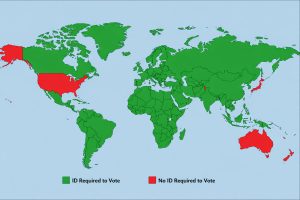 There is no single official list of all countries requiring ID to vote, because some require ID, some require registration cards, some require ID only if requested.
However, political science and election law sources show that most countries require some form of identification to vote in person.
Europe
Most European countries require a national ID card or passport.
Countries requiring ID to vote:
- United Kingdom
- Germany
- France
- Italy
- Spain
- Greece
- Belgium
- Netherlands
- Switzerland (ID may be requested)
- Ireland (ID required)
- Iceland
- Hungary
- Poland
- Norway
- Sweden
- Finland
- Denmark (ID sometimes requested depending on voter list)
- Portugal
- Austria
- Czech Republic
- Slovakia
- Slovenia
- Estonia
- Latvia
- Lithuania
- Romania
- Bulgaria
- Croatia
Many European countries already issue national ID cards, so voters typically must show them at polling stations.
Americas
Countries requiring ID:
- Canada (ID required, multiple forms allowed)
- Mexico (mandatory voter ID card)
- Brazil (voter ID or ID number)
- Argentina
- Chile
- Colombia
- Peru
- Uruguay
- Dominican Republic
- Panama
- Costa Rica
- Guatemala
Africa
Many African countries use biometric voter ID systems.
Examples:
- South Africa
- Nigeria
- Ghana
- Kenya
- Tanzania
- Uganda
- Zambia
- Zimbabwe
- Namibia
- Mozambique
- Senegal
- Sierra Leone
- Malawi
- Liberia
- Lesotho
- Botswana
- Morocco
- Egypt
Many of these countries require biometric voter registration and ID verification before voting.
Asia & Middle East
Countries requiring ID:
- India
- Israel
- Pakistan
- Bangladesh
- Indonesia
- Philippines
- Malaysia
- Turkey
- Iran
- Iraq
- Saudi Arabia
- United Arab Emirates
- Japan (ID often required if not recognized)
- South Korea
- Thailand
Oceania
Countries requiring ID:
- Australia (generally not required in person, but identity verification exists)
- New Zealand (generally not required)
- Fiji (ID required)
- Papua New Guinea (ID often required)
Countries That do NOT Require ID to Vote
These rely on voter rolls and signatures:
- Australia
- New Zealand
- Denmark
- Some U.S. states
- Some Swiss and Irish elections (ID only if requested)
If most countries require identification to vote, and the United States is the outlier, it raises the question of why the US would consider a practice undemocratic that most democracies consider standard.
Partisan Perspectives, But Consistent Majorities
While Democrats and Republicans may differ sharply on many aspects of election administration, polling consistently shows that large majorities of both parties favor voter ID requirements.
Data reported by Gallup indicate that Republican support for photo ID laws routinely exceeds 90%. At the same time, Pew Research has found that roughly 69–71% of Democrats also support requiring photo identification when voting. Independents similarly register strong approval, often landing between the two major parties.
The significance of these numbers should not be understated. When nearly seven in ten Democrats and more than nine in ten Republicans support a policy, it is difficult to characterize that position as partisan extremism. Rather, it reflects a shared public expectation that voting procedures include verification safeguards.
Why These Numbers Matter for Legal Policy
For lawmakers and courts alike, public opinion does not dictate constitutional outcomes—but it does inform policy debates. When more than four out of five Americans favor a particular election safeguard, it signals that confidence in electoral systems is a paramount public concern.
Opponents of voter ID laws frequently argue that such measures risk disenfranchising certain voters. These concerns warrant serious consideration and careful legislative drafting. However, the polling data suggest that the electorate broadly perceives ID requirements as a common-sense election integrity measure.
Courts reviewing voter ID statutes often examine whether the burden imposed is substantial. From a policy perspective, reforms can—and should—be structured to provide free identification options and reasonable accommodations while still maintaining verification standards.
Legal analysis benefits from acknowledging that public confidence in elections is itself a legitimate governmental interest.
Polling Nuance: Framing Matters
It is important to recognize that question wording in polling can influence responses. As summarized in discussions of voter identification laws on Wikipedia’s overview of U.S. voter ID laws, support tends to increase when surveys emphasize ensuring election integrity and may decrease somewhat when highlighting potential obstacles faced by voters without identification.
Even accounting for these framing effects, however, majorities of Americans consistently support voter ID requirements across survey instruments and over time.
Aligning Law With Public Expectations
The data are remarkably consistent: a substantial majority of Americans believe that requiring government-issued photo identification to vote is reasonable and appropriate.
For legal practitioners, policymakers, and scholars, this reality matters. The constitutional conversation surrounding voting rights must carefully balance access and integrity. But the public’s sustained support for voter ID requirements demonstrates that Americans widely view identification safeguards as compatible with democratic participation.
Voter ID laws are not a marginal position—they are reflective of mainstream public sentiment. As election law continues to evolve, any serious legal analysis must grapple not only with constitutional doctrine and statutory language, but also with the clear and repeated voice of the electorate.